
Morphology

Morphology is the branch of linguistics that deals with words, their forms, their internal structures and how they are formed. The word,morphology, was coined in the second half of the nineteenth century by a German poet, novelist, playwright and philosopher, Joham Wolfang Von Goethe (1749-1832). It had a biological reference meaning ‘the study of the form of animals and plants’. The word is derived from two Greek words- morph meaning shape or form and –logy which means knowledge. August Schleicher (1859) was the first to use the word ‘morphology’ in the linguistic sense. Morphology therefore refers to the knowledge or study of forms or shapes of words. 

Morphology studies the internal structure of words and word formation rules. Howard and Etiene (2007, p. 3) define it as ‘the study of morphemes and their arrangements in forming words’. It is concerned with the forms of words, how they are formed and how they are inflected. It describes morphemes and how they occur within a word. Haspelmath and Sims (2010, p.3) see morphology as ‘the study of the combination of morphemes to yield words’.

Thus, morphology studies the formation of words. Since languages always have a need to create more words and thereby enlarge their lexicon, morphology provides the rules that govern the formation of meaningful words in a language. These rules lead to the derivation of complex words. Morphology is the study of the smallest meaningful unit of a language. Itstudies how this smallest meaningful unit combines to form words. The basic concept studied in morphology is the morpheme

Morphology studies word structure and the importance of words cannot be over-emphasized. It interfaces between phonology, syntax and semantics, hence the field of morpho-phonology, morpho-syntax and morpho-semantics. Morphology is language specific i.e. the expressions of morphology in languages differ. What language A expresses via morphology is expressed via words in language B. For example, Igala and Hausa express pluralization by means of morphology while Yorùbá makes use of a word. The plural form is expressed via inflections in Igala and Hausa but not in Yoruba. The morpheme am- is prefixed to nouns to form plural nouns while in Yorùbá the word àwọn is used to express plurality. English makes use of the morpheme –ed to mark past tense while in Yorùbá past tense is not morphologically marked; it is implied. Hausa has resumptive pronouns and also marks gender on it. Yorùbá neither use resumptive pronouns nor mark gender. Consider the following examples (the Igala data is taken from Ilori (2009, p. 2-3) while the Hausa data is from Amfani (2010, p. 149-150).

Igala1. Singular​​​​Plurala. éwó​‘goat’​​​àm-éwó​‘goats’b. íkélékwu​‘rat’​​​àm-íkélékwu​‘rats’c. àtá​​‘father’​​​àm-`atá​‘fathers’d. agboji​‘leader’​​àm-agboji​‘leaders’

Hausa2. Singular​​​​Plurala. gídá​‘house’​​​gídà-jé​​‘houses’b. kwáná​‘day’​​​kwànà-kí​‘days’c. fárí​​‘white’​​​fárà-ré​​‘whites’d. sábó​‘new’​​​sàb-àbbí​‘new ones’

Yoruba3. Singular​​​​Plurala. obìnrin​‘woman’​​àwọnobìnrin​‘women’b. ilé​​‘house’​​​àwọnilé​‘houses’c. igi​​‘tree’​​​àwọnigi​‘tress’d. àga​​‘chair’​​​àwọnàga​‘chairs’

English 4. Present Tense​​Past Tensea. walk​​​walk-edb. laugh​​​laugh-edc. smile​​​smil-edd. cough​​​cough-ed

Hausa5. Masculine​​    Femininea. jakí​​​     jàká​​‘donkey’b. dìllálì​​    dìllálìyá​‘visitor’c. fárí​​​    fárá​​‘white’d. tsófó​​    dógúwá​‘ old’6. a.​àbíncí yá ​á ​​dàfú

​N​AGR​Tense-ASP​V​

​food    3MS​NF PERF​cook

​‘Food is well cooked.’

b.​mótà tá      á ​​sàyú

​N      AGR Tense-ASP V

​car   3FS   NF​buy

​‘The car is well purchased.’

Looking at the examples above, we could say that Igala, Hausa, and English make more use of morphology than Yorùbá. This means that the morphological typology of languages differs. 

The knowledge of a language implies the knowledge of every aspect of the language including its morphology. A speaker who has the knowledge of his language knows about the possible types of words in the language, knows about the forms and shapes of words in the language, has knowledge about the internal structure of words in the language and also knows about rules governing word formation. He is able to make judgments about possible derived words and types of inflections in the language.

References

Arokoyo, Bolanle Elizabeth. (2017). Unlocking morphology. Ilorin: Chridamel Publishing House.

Haspelmath, Martins and Andrew Sims (2010). Understanding morphology. London: Hodder Education.

Tallerman, Maggie. (2009). Understanding syntax. London: Hodder Arnold.
Inflectional Morphology

1. Inflectional Morphemes

We are gradually coming to the end of our discussion on the The Morpheme and it’s functions. The previous lecture was on Derivation  of Adjectives and Adverbs. Get yourself acquainted with the lectures, please.

Our lecture today is on inflectional morphology. We will examine inflectional morphemes and morphosyntax.

Inflectional morphemes are purely grammatical markers; they give additional information about tense, number, gender, case, tense, aspect andmood. 

They express grammatical relationsbetween the word forms of a lexeme. 

Inflectional affixes show if a verb is present or past, perfective or progressive, if the noun or pronoun is singular or plural, nominative, accusative or oblique, masculine, feminine or neuter, if an adjective is comparative or superlative. 

Since they are not derivational, they do not change the class of the word they are attached to nor the meaning. 

They are usually attached to complete words and they close grammatical forms. 

Both lexical and functional morphemes are open to inflections.

Different languages code inflection differently.

The languages that are classified as inflectional/ fusional exhibit a very rich inflectional base compared to languages that are classified as agglutinating and isolating at the end of the spectrum. 

Due to the nature of inflectional languages, some of the affixes cannot be segmented to actually see how the different case features are bundled. 

Despite the fact that not all languages code all inflections but the inflectional types cut across languages.

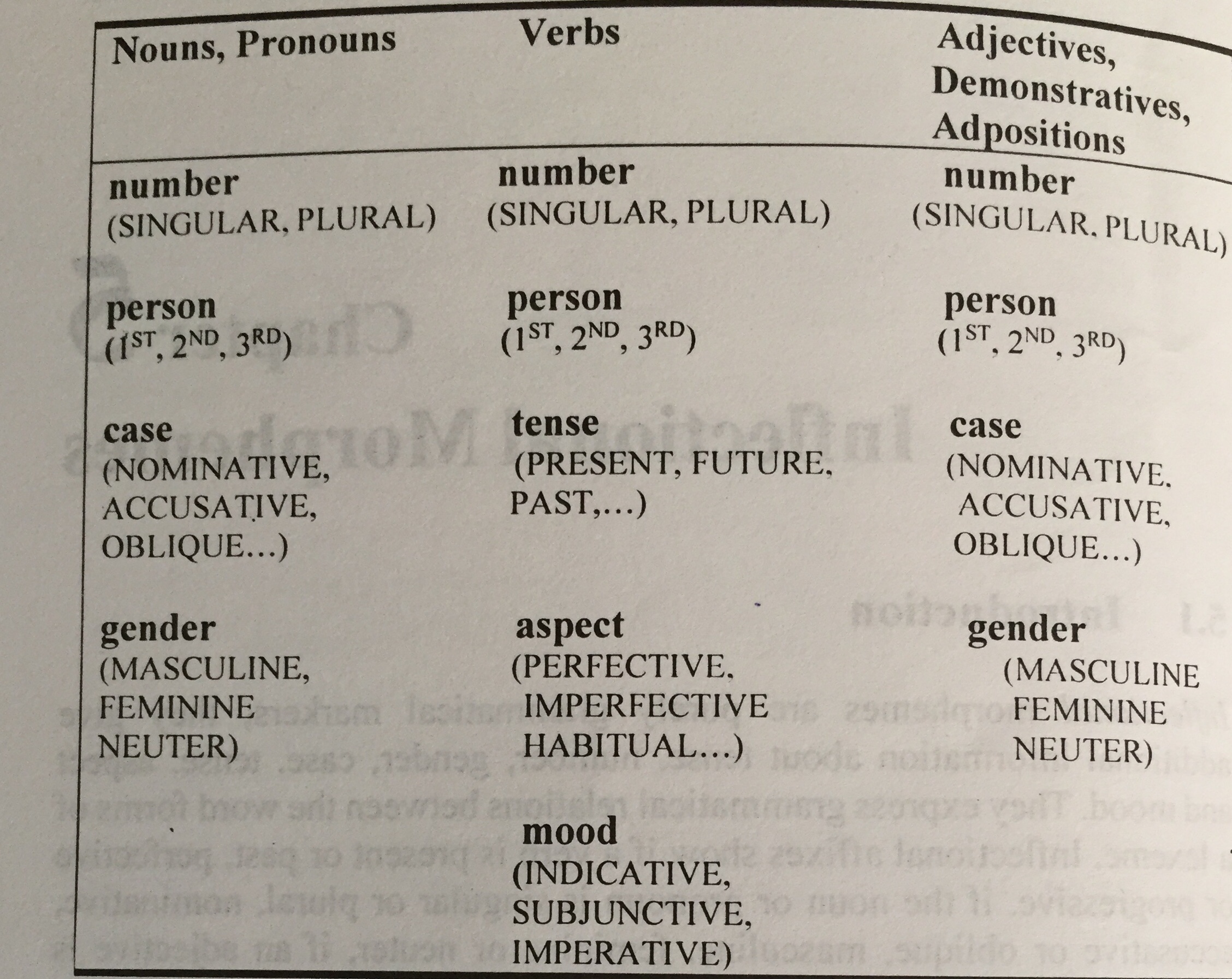
We can see from Table 1 the classes of inflections and the recipients.


Nouns, Pronouns            Verbs                               Adjectives, 

                                                                                Demonstratives,        

                                                                                 Adpositions

number                         number                             number

(SINGULAR, PLURAL)      (SINGULAR, PLURAL)          (SINGULAR, PLURAL)


person                             person                               person

(1ST, 2ND, 3RD)                         (1ST, 2ND, 3RD)                           (1ST, 2ND, 3RD)


case                                 tense                                  case

(NOMINATIVE,                    (PRESENT, FUTURE,             (NOMINATIVE, 

ACCUSATIVE,                     PAST,…)                                    ACCUSATIVE, 

OBLIQUE)                                                                              OBLIQUE…)  


gender                             aspect                                 gender

(MASCULINE,                       (PERFECTIVE,                               (MASCULINE

FEMININE                                IMPERFECTIVE                            FEMININE

NEUTER)                                  HABITUAL…)                            NEUTER)     


                                                 mood

                                               (INDICATIVE, 

                                                SUBJUNCTIVE, 

                                                 IMPERATIVE)

Table 1: Classes of Inflections and the Recipients

From the table above, we can deduce that inflections are grouped together into values. 

The grammatical information in the table above when affixed to the recipients do change their forms.

As indicated in the table above, each word class has inflectional affixes that are unique to it. 

For example the feature person is distinguished into 1st, 2nd or 3rd person and it is a feature of the noun and the pronoun, the verbalso has to agree with the feature. 

Another inherent inflection for nouns and verbs are number, gender, noun class, definiteness and case. 

Inflection features for verbs include tense, aspect, mood and voice.

The verb in most cases has to agree with the features of its arguments especially the external argument.

Adjectives are inflected for degrees of comparison which is either comparative or superlative while there are also agreement features for the adjectives too.

In Hausa, for example, the adjective is inflected for plural if the head of the Noun Phrase (NP) that it is modifying is plural. 

Determiners, demonstratives, pronouns, and adjectives are also marked for gender and any of them modifying a noun must also agree with the gender feature of the noun being modified.Consider the following French data.

1.

a. la fille la fille blanche

fem. fem. fem. fem. fem.

‘the girl‘ ‘the white girl’

b. le livre. le livre blanc

masc. masc. masc. masc. masc.

‘the book’ ‘the white book’

2.

a. une fille une fille blanche

fem. fem. fem. fem. fem.

‘a girl’ ‘a white girl’

b. un livre un livre blanc

masc. masc. masc. masc. masc.

‘a book’ ‘a white book’

When a noun begins with a vowel, the article used is l’ followed by the word.

In cases like that, the gender status of the word might have to be learnt.

However, for nouns that have either masculine or feminine status, the ending will show whether the word is masculine or feminine, the feminine always end with –e.

3. FeminineMasculine

a. l’étudiante  l’étudiant ‘student’

b. la voleuse le voleur ‘thief

c. la chercheuse le chercheur ‘scientist’

The basic fact of agreement which inflectional morphemes embody is that the inflectional value of the head of a phrase or sentence must agree with the inflectional values of the constituents.

This is saying that the head and its constituents must agree in inflectional features. 

Consider the following examples from Gunnin, an Australian language taken from Tallerman (2009, p. 59).

4.

a. benyjin      bi-yangga

man     GENDER goes

‘The man is walking.’

b. leewa gadi a-yangga

dog    run  GENDER-goes

‘The dog is running.’

The verbs in the examples agree with the gender feature on the subjects.

The gender for human noun and animate noun in the language is different. 

Inflection is relevant to syntax. It shows the grammatical function or meaning expressed by a morphological pattern in syntactic agreement or government (Haspelmath and Sims, 2010, p. 91). 

Agreement refers to the marking of morphosyntactic properties of the head on the dependents. 

Whatever heads a phrase determines the agreement. The noun determines the agreement properties of its dependent like the determiners, demonstratives and attributiveadjectives.

The verb may also have to agree in number, person and gender with the noun in either subject position or object position. 

The preposition may also agree with the object noun phrase in person number and gender. 

This shows that there is an intrinsic relationship among the members of a clause.

There is an interface between the grammatical information provided by the inflectional morphemes and the syntax. 

Inflectional morphology provides the need for the morphological and syntactic interface hence, morphosyntax.

2. Morphosyntax 

Morphosyntax studies grammatical units that have both morphological and syntactic properties.

It is the set of rules that govern grammatical units whose features are definable by both morphological and syntactic criteria.

These grammatical units are definable using both morphology and syntax as they apply to words.

Grammatical categories like NUMBER, CASE, GENDER, PERSON, TENSE, ASPECT, etc. are morphosyntactic.

Number contrast for example is morphosyntactic in most languages.

Number contrasts require a morphological marking with an affix, for example the suffix –s in English and it also affects syntax because of the agreement between the subject and the verb.

There are languages, for example Hausa, where the adjective must also agree with the noun it is modifying.  

Exercises

1. Examine how gender is marked in at leastthree languages. Provide examples in each language.

2. Describe how case is marked in at least three languages. Show the case declension in the language. Provide examples in each language.

3. Conduct some research in five languages of your choice where tense is morphologically marked. How is tense marked in those languages? Provide sufficient examples. Contrast tense marking the languages.

4. Some languages distinguish number as singular and plural, others distinguish as singular and non-singular. Discuss how number is indicated in the two broad categories.

5. Describe inflectional affixes.

NB

a. In the next lecture, we will examine morphological processes. .


b Excerpts are taken from Arokoyo (2017).

References

Arokoyo, Bolanle Elizabeth. (2017). Unlocking morphology. Ilorin: Chridamel Publishing House.

Haspelmath, Martins and Andrew Sims (2010). Understanding morphology. London: Hodder Education.

Tallerman, Maggie. (2009). Understanding syntax. London: Hodder Arnold.

Derivation  of Adjectives and Adverbs

Bolanle Elizabeth Arokoyo

Morphology Lecture Series XI

We will conclude our discussion of Derivational Morphemes by looking at adjective and adverb derivations today. The last topic discussed was Verb Derivation. Endeavour to read the previous topics.

1. Adjective Derivation

Adjective is a lexical category that serves to qualify noun. It occurs as a modifier in noun phrases.

Adjectives can be derived from nouns, verbs and also from adjectives giving rise to denominal adjectives, deverbal adjectives and deadjectival adjectives.

1.1 Denominal Adjectives

Denominal adjectives are derived from nouns.

Relational adjectives (adjectives with a relation to the base noun and derived from noun), privative adjectives (adjectives derived from nouns indicating lack of possession of a noun), material adjectives (adjectives indicating materials used in creation), possession adjectives (adjectives indicating ownership), resemblance adjectives (adjectives indicating similarities), proprietive adjectives (adjectives indicating possession of the base noun), etc. are some adjective types that can be derived from nouns. In

English for example, the suffixes –ful, –an, -ly, -ish etc. are added to noun bases to derive proprietive adjectives.

1. Noun Adjective

a. beauty beauty-ful

b. hand hand-ful

c. Nigeria Nigeri-an

d. America Americ-an

e. man man-ly

f. coward coward-ly

g. boy boy-ish

h. girl girl-ish

In Tagalog, tones serve as the affix to derive also proprietive adjectives from nouns. Consider the following examples taken from Haspelmath and Sims (2010, p. 56).

2. Noun Adjective

a. búhay ‘life’ buháy ‘alive’

b. gútom ‘hunger’ gutóm ‘hungry’

c. tákot ‘fear’ takót ‘afraid’

d. hábaɁ ‘length’ habáʔ ‘long’

e. gálit ‘anger’ galít ‘angry’

To derive adjectives in the language, the high tone on the vowel in the first syllable is elided and the vowel in the second syllable receives the high tone.

The suffix –less in English derives privative adjectives. Consider the following examples in (3).

3. Noun Adjective

a. pepper pepper-less

b. water water-less

c. colour colour-less

d. paper paper-less

English derives material adjectives with the addition of suffixes –en, -ic, etc. to specific nouns.

4. Noun Adjective

a. wood wood-en

b. wool wooll-en

c. gold gold-en

d. metal metall-ic

English also derives adjectives with the meaning of covering with the suffix –y as shown in the following examples.

5. Noun Adjective

a. velvet velvet-y

b. wool wooll-y

c. wood wood-y

d. stone ston-y

Modern Arabic uses the nisba suffix i.e. relational suffix to derive material, possession and resemblance adjectives.

These three adjectival kinds express relations. Let us consider the following examples taken from Druel and Grandlaunay (2008, p.379).

6. Noun Adjective

a. ʤibs ‘plaster’ ʤibs-i: ‘made of plaster’

b. ħadi:d ‘iron’ ħadi:d-i: ‘made of iron’

c. blastik ‘plastic’ blastik-i: ‘made of plastic’

7. Noun Adjective

a. ʤabal ‘moutain’ ʤabal-i: ‘mountanous’

b. ʃaʼr ‘hair’ ʃaʼr-a:n-i: ‘hairy’

c. duhn ‘grease’ duhn-i: ‘greasy’

8. Noun Adjective

a. tibn ‘straw’ tibn-i: ‘straw coloured’

b. muxmal ‘velvet’ muxmal-i: ‘velvety’

c. ˀisfi:n ‘wedge’ ˀisfi:n-i: ‘wedge shaped’

From the examples above indicating the derivation of material adjectives in (6) possession adjectives in (7) and resemblance adjectives in (8) from nouns, since they all have the same suffix, the resultant adjective is determined by the type of noun the denominal suffix -i is attached to.

Relational adjectives express the relation between it and the head noun. Let us see the following examples in (9).

9. Noun Adjective

a. government government-al

b. element element-al

c. judgment judgment-al

d. medicine medicin-al

e. industry industry-al

f. relation relation-al

In English, denominal relational adjectives could be derived with the suffix –al as indicated in the examples above.

1.2. Deverbal Adjectives

Deverbal adjectives are adjectives derived from verbs.

Facilitative (an adjective meaning ‘able to undergo an action’) and agentive (an adjective indicating an action performed by the noun) adjectives are some of the kinds of adjectives derived from verbs. Consider the following examples.

10. Verb Adjective

a. read read-able

b. like like-able

c. carry carry-able

d. manage manage-able

The suffix –ive is attached to the following verbs to derive adjectives.

11. Verb Adjective

a. attract attract-ive

b. elude elus-ive

c. suggest suggest-ive

d. prohibit prohibit-ive

1.3. Deadjectival Adjectives

Deadjectival adjectives are adjectives derived from other adjectives.

The kinds of adjectives derived from others include negative adjective (an adjective indicating a reversal of the values of the base adjective), attenuative adjective (an adjective that indicates a reduced degree of the base adjective), intensive adjective (an adjective indicating an increased degree of the base adjective), etc.

German uses the prefix un- to derive negative adjectives from other adjectives.

12. Adjective Adjective

a. schön ‘beautiful’ un-schön ‘ugly’

b. glücklich ‘happy’ unglücklich ‘unhappy’

c. bestimmte ‘countable unbestimmte ‘uncountable’

The affixes un-, il-, in-, etc. are attached to adjectives to derive negative adjectives in English. For example:

13. Adjective Adjective

a. happy un-happy

b.  approachable un-approachable

c.  logical il-logical

d. legal il-legal

e. eligible in-eligible

f. competent in-competent

The suffix –ish derives attenuative adjectives in English as indicated in the examples in (14).

14. Adjective Adjective

a. red red-ish

b. pink pink-ish

c. green green-ish

d. white whit-ish

Tzutujil also derives attenuatives using the duplifix –Coj. Consider the following examples taken from Dayley (1985, p213).

15. Adjective Adjective

a. saq ‘white’ saq-soj ‘whitish’

b. rax ‘green’ rax-roj ‘greenish’

c. q’eq ‘black’ q’eq-q’oj ‘blackish’

d. tz’iil ‘dirty’ tz’il-tz’oj ‘dirtyish’

In deriving intensive adjectives, there is the partial reduplication of the initial syllable with the addition of an interfix in Turkish. Consider (16).

16. Adjective Adjective

a. kirmizi ‘red’ kip-kirmizi ‘all red’

b. kolay ‘easy’ kop-kolay ‘extremely easy’

c. beyaz ‘white’ bem-beyaz ‘all white’

d. temiz ‘clean’ ter-temiz ‘completely clean’

In the derivation of some of these adjectives as indicated in the Tzutujil and Turkish examples, we see that partial reduplication is used.

2. Adverb Derivation

An adverb is a lexical category that modifies the verb and the adjective.

Adverbs could be derived from verbs, adjectives and nouns through the process of affixation.

Adjectives easily receive affixes to derive adverbs in English. For example:

17. Adjective Adverb

a. high high-ly

b. easy easi-ly

c. foolish foolish-ly

d. beautiful beautiful-ly

The addition of the prefix a- to adjectives verbs and nouns also derive adverbs. For example:

18. Adjective Adverb

a. long a-long

b. far a-far

c. lone a-lone

d. loud a-loud

19. Verb Adverb

a. stray a-stray

b. drift a-drift

c. board a-board

d. miss a-miss

20. Noun Adverb

a. head a-head

b. pace a-pace

c. breast a-breast

d. back a-back

Examples (18) show adverbs derived from adjectives, (19) indicate adverbs derived from verbs while (20) exemplify adverbs derived from nouns.

Combining the suffix –wise and –ward to some kinds of nouns in English derives adverbs as exemplified in (21).

21. Noun Adverb

a. clock clock-wise

b. street street-wise

c. east east-ward

d. north northward

The suffix –wise indicates behavior while suffix –ward indicates direction.

Adverbs are also derived from other adverbs. For example, the prefix anti- added to the adverb clockwise will derive anti-clockwise, also an adverb.

 Exercises

1. Describe how adjectives are derived.

2. Discuss the derivational functions of affixes.

3. Consider the following data from Kannada. Determine the meaning of the suffixes.

khacita ‘certain’ khacitate ‘certainty’

bhadra ‘safe’ bhadrate ‘safety’

ghana ‘weighty’ ghanate ‘dignity’

(Sridhar 1990, p270, 278)

4. With ample illustrations, describe how adverbs are derived.

NB

a. We will start our discussion of Inflectional Morphology from the next lecture.

b Excerpts are taken from Arokoyo (2013, 2017 and 2018).

References

Arokoyo, Bolanle Elizabeth. (2013). Owé linguistics: an introduction. Ilorin: Chridamel Books. https://www.researchgate.net/publication/325247296_Owe_Linguistics_an_Introduction

Arokoyo, Bolanle Elizabeth. (2017). Unlocking morphology. Ilorin: Chridamel Publishing House.

Arokoyo, Bolanle Elizabeth. (2018). Owé linguistics: an introduction. Aba: NINLAN

Dayley Jon P. (1985). Tzutujil grammar. Berkeley: University of Carlifornia Press.

Druel, Jean N., Du Grandlaunay René-Vincent. (2008). Nisba. In Versteegh, K. (ed.), Encyclopedia of Arabic Language and Linguistics. Vol. III: Lat-Pu. Leiden/Boston: Brill, 2008, pp. 377-381.

Haspelmath, Martins and Andrew Sims (2010). Understanding morphology. London: Hodder Education.