
Compounding: A Word Formation Process

Bolanle Elizabeth Arokoyo

Morphology Lecture Series XVI

Compounding is a morphological process in which two or more separate words are combined to form a new compound word.  

The meaning of the new word is not entirely predictable on the components that make up the word.

Different lexical categories can be combined to form compound words.

There are noun-noun compounds, adjective-noun compounds, noun-verb compounds, verb-verb compounds, adjective-adjective compound, etc. When the two compounded words are in the same category, the derived compound will be in that same category. Let us look at the following noun-noun compounds in Yoruba.

1.  Noun     Noun Noun

a. ilé           ìwè → iléwè ‘school’

house      book  

b. ọmọ ọ̀dọ̀ → ọmọdọ̀ ‘maid’

child  place

c. aya        ọba → ayaba ‘queen’

wife       king

d. ìyá     ilé → ìyálé ‘senior wife’

mother  house

In Yoruba, the first word in the compound serves as the head and determines the lexical category of the new compound.

When the compounded word belongs to the different lexical categories, the derived compound will belong to either of the lexical categories.

In English, the second or rightmost word in the compound is the head of the compound and determines the lexical category of the new compound word.

Types of compounds include, compound nouns, compound verbs and compound adjectives. Let us consider the following different combinations of words to form compounds in English.

2. Noun Noun Noun

a. egg head egghead

b. mail man mailman

c. house fly house fly

d. chair man chairman

3. Verb Noun Noun

a. play ground playground

b. pick pocket pickpocket

c. call       girl call girl

d. draw bridge drawbridge

4. Adjective Noun Noun

a. black bird blackbird

b. green house greenhouse

c. black board blackboard

d. blue bell bluebell

The examples in (5) below show verb plus noun compounds in German.

5. Verb Noun

a. wasch maschine

wash    machine

Noun: wasch-maschine

‘washing machine’

b. saug pumpe

suck pump

Noun: saug-pumpe  

‘suction pump’

c. schreib tisch

write desk

Noun: schreib-tisch  

‘writing desk’

6. Preposition Verb Verb

a. down size downsize

b. up date update

c. out source outsource

d. over act overact

7. Verb Verb Verb

a. stir fry stir-fry

b. freeze dry freeze-dry

c. blow dry blow-dry

d. type setting type setting

8. Noun Verb Verb

a. steam clean steam-clean

b. hand wash hand-wash

c. brow beat browbeat

d. man handle manhandle

9. Adjective Verb Verb

a. dry clean dry-clean

b. white wash white-wash

c. high light high-light

d. black list blacklist

The compounds derived in data 1-5 are refered to as compound nouns while the examples in (6-9) are compound verbs. Compound adjectives are exemplified in data (10-12) below.

10. Adj AdjAdj

a. red hot red-hot

b. black blue black-blue

c. dark yellow dark-yellow

d. blue green blue-green

11. Noun Adjective Adjective

a. coal black coal-black

b. gold rich gold-rich

c. sky high sky-high

d. snow white Snow White

12. Prep. Adjective Adjective

a. over active overactive

b. under active underactive

c. over ripe over-ripe

Compounds are sometimes made up of more than two words like daughter in law, mother in law, man about town, sergeant at arms, etc. In instances like this in English, the compounds are head first followed by the modifiers.

Yoruba also attest three-word compounds like ọmọ iléèwé, ‘head of school’, ọ̀gá iléesẹ́ ‘company head’, etc.

The head in three-word compounds still retains the head first position as is the case with other compounds.

There are different conventions adopted in the spelling of compounds. Some compounds are written together like pickpocket, playground, landlord, some are written with a space between the compounds like smoke screen, church mouse, while some compounds are hyphenated like red-hot, icy-cold, etc.

There is a difference between compound words and phrases. Compound words and phrases behave differently.

A compound word is an entity, a whole, but with a head. A phrase could be made up of a word or more and also has a head.

When a phrase is made up of two or three words, it may look like a compound word. The English compound cited above and repeated in (13) could safely be verb phrases too.

13.

a. play ground playground

b. pick pocket pickpocket

c. call      girl call girl

d. draw bridge drawbridge

The compound and the verb phrase are structurally different and also have different heads. Consider the following sentences.

14.

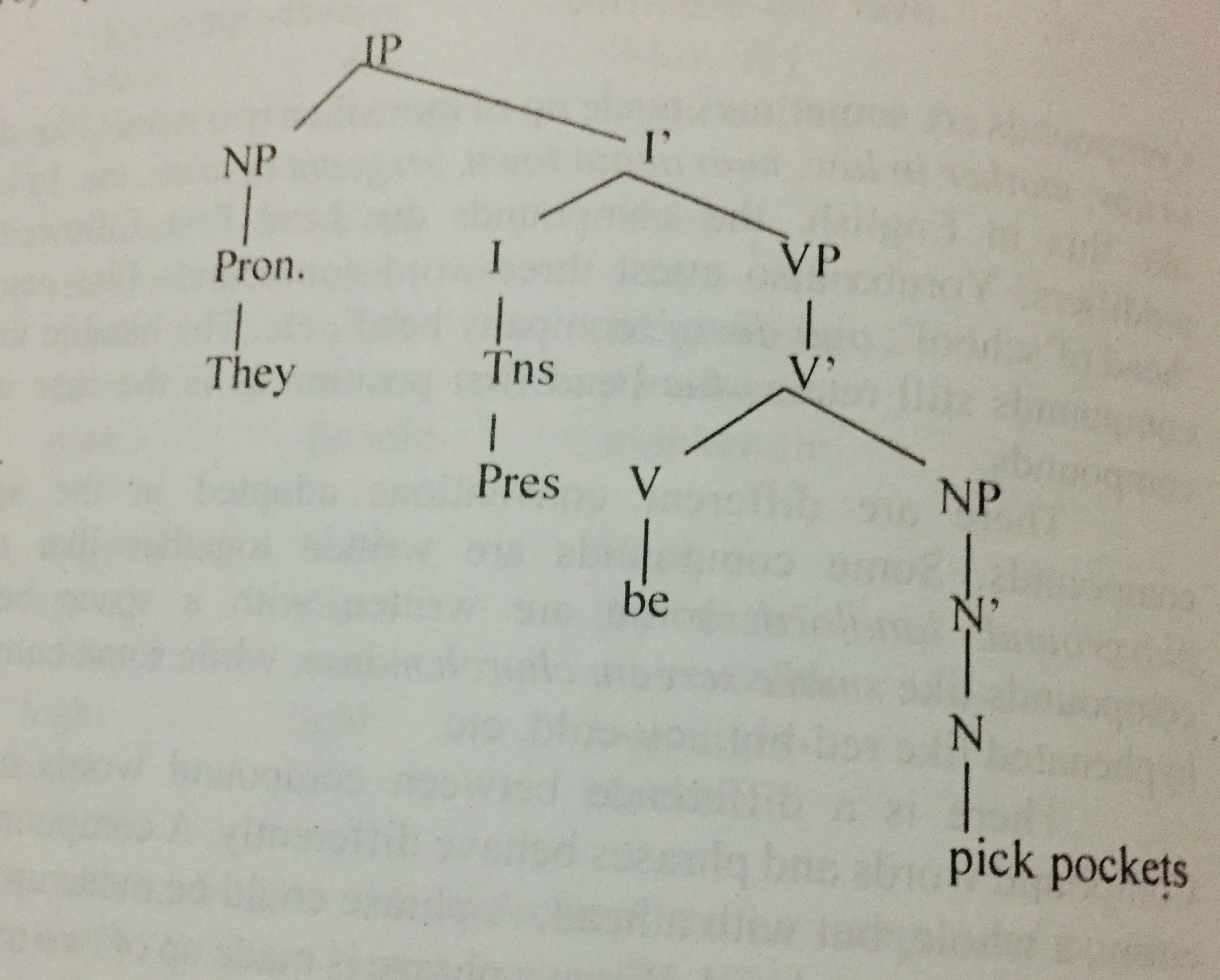
a. they are pick pockets.

b. they pick pockets.


They are represented in the following tree diagrams, (15) represents (14a) while (16) represents (14b).

15.
16.
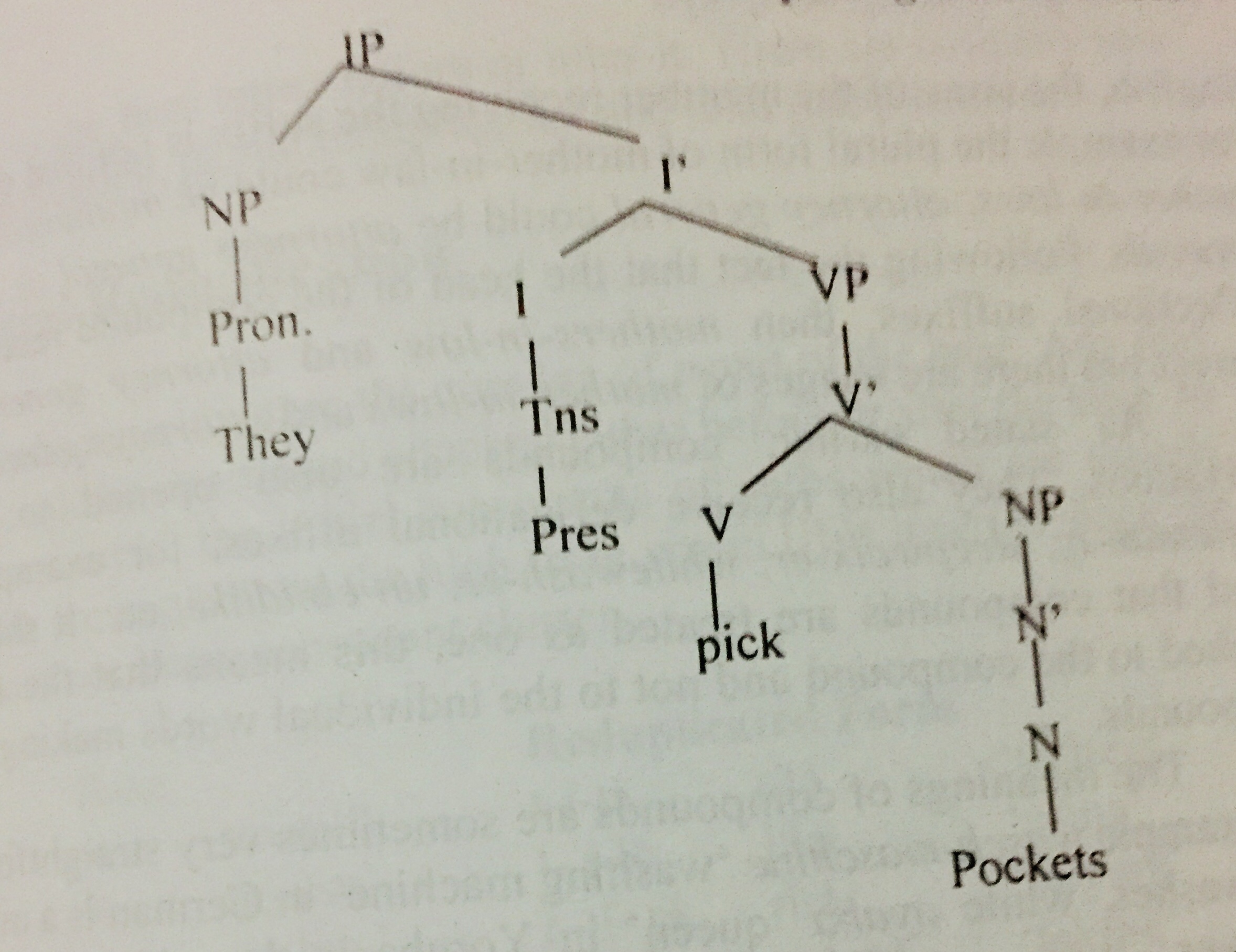
from the diagram above, we can see that the compound pickpockets in (15) is an NP while in (16) the verb pick heads the VP that pockets belong.

Compounds like other words are also opened to being further derived and also receive inflectional affixes.

They are treated and stored as single words. In English, compounds can be inflected for all grammatical categories. Consider the following

17.

a. pickpockets, blackboards, playgrounds, call girls, chairmen,

b. downsizes, updates, outsources, overacts

c. downsized, updated, outsourced, overacted

d. downsizing, updating, outsourcing, overacting

These examples show plural, third person singular, past, and progressive marked on the nouns and verbs respectively.

We can see that the inflectional suffixes are marked on the second member of the compound which is the head and the determiner of the category of the word.

In the case of three-word compounds and some words that are borrowed into English, the issue of the member receiving the suffix is not that clear-cut.

For example the plural form of mother-in-law could be mothers-in-law or mother-in-laws, attorney general could be attorneys general or attorney generals.

Following the fact that the head of the compound receives the inflectional suffixes, then mothers-in-law and attorney generals are correct but there are usages of mother-in-laws and attorneys general.

As stated earlier, compounds are also opened to further derivations.

They also receive derivational affixes, for example, un-gentleman-ly, sleepwalk-er, whitewash-er, un-childlike, etc.

It should be noted that compounds are treated as one, this means that the affix is attached to the compound and not to the individual words making up the compounds.

The meanings of compounds are sometimes very straightforward. For example wasch-maschine ‘washing machine’ in German is a machine that washes, while ayaba ‘queen’ in Yoruba is the wife of the king.

However, it is not always that meanings of compounds are so straightforward. In some cases, the meaning is a combination of the meaning of the words making it up.

Sometimes, the meaning show the relationship between the compounds, at times, the compounds are simply idiomatic and there are instances when the real meaning is lost.

In English, egghead does not mean a person with a head shaped like an egg or a head of eggs but an intelligent person who is only interested in studying, a laughing gas does not mean a gas that laughs but nitrous oxide used as a form of anesthesia, neither does turncoat mean a person who turns his coat but a traitor.

Each of these compounds has a history or etymology behind them.

Exercises

1. With illustrations in at least two languages, discuss how words are formed.

2. What is compounding?

3. Discuss the different types of compounds, with ample data.

NB

a. Excerpts are taken from Arokoyo (2017 and 2018).

b. For previous lectures on morphological processes, see Borrowing and Acronyms

References

Arokoyo, Bolanle Elizabeth. (2018). Owé Linguistics: an Introduction. Aba: NINLAN. https://bit.ly/36uYAFw

Arokoyo, Bolanle Elizabeth. (2017). Unlocking Morphology. Ilorin: Chridamel Books.
Borrowing: Languages in Contact

Bolanle Elizabeth Arokoyo

Morphology Lecture Series XV

Borrowing is a common morphological process that involves taking words from one language to another.

Any language in contact will definitely have borrowed words.

These words are refered to as loanwords.

The essence of borrowing is to cope with new ideas and concepts that are unfamiliar to the receiving language.

Once languages come in contact, there will definitely be borrowed words as vestiges of the contact.

Words are also borrowed to replace expressions which have disappeared from the lexicon of the host language.

Borrowing enhances communicative competence of some speakers and also enriches the receiving language.

The words that are borrowed are however, made to conform to the phonological and morphological specification of the host language.

English has so many loan words in its lexicon among which are: anchor, cheese, kitchen, church, pepper, sickle, paper, martyr, tailor, piano, wine, etc. (Latin); advertise, calendar, rent, science, war, attorney, beef, pendant, person, garage, duke, etc. (French); atmosphere, parasite, skeleton, tragedy, climax, comedy, etc. (Greek); cockroach, adobe, mosquito, ranch, guitar, embargo, vigilante, etc. (Spanish); alcohol, algebra, almanac, algorithm, etc. (Arabic); tycoon judo, hara kiri, karaoke, tsunami, etc. (Japanese); zebra (Bantu); egg, sky, (Danish); etc.

Add your own.

Borrowing is broadly classified into direct borrowing and indirect borrowing.


1. Direct Borrowing

Direct borrowing, also called assimilator borrowing, is the type of borrowing where words are not subjected to major phonological or morphological modifications.

The borrowed words retain their original form and meaning; some however have little variation. English has many borrowed words from Latin, Greek and French.

For example bonus, alumnus, quorum, exit scientific, etc are borrowed from Latin; drama, comedy, scene, botany, physics, etc. are borrowed from Greek, while crown, jury, royal, charity, lechery, attorney, parliament, nation, etc. are words that came into English from French.

The data below show borrowed words into Yoruba from English and Hausa.

 1.

SourceWordYoruba

English

table tébù ‘table’

peter pita ‘Peter’

motor mọ́tò ‘motor’

barber bábà ‘barber’

Hausa

súya súyà ‘barbeque’

aluabarka    àlùbàríká ‘blessing’

The following data taken from Iloene (2010, p. 199-200) illustrate borrowed English, Hausa, Yoruba and Efik words in Igbo.

2.

Source Word Igbo Gloss

English

atom atom ‘atom’

limbo limbo ‘limbo’

Hausa

súyà súyà ‘roast meat’

wàyó wàyó ‘cheat, trick’

Yoruba

àkàrà àkàrà ‘bean nuggets’

ibà íbà ‘fever’

Efik

ekpo ekpo ‘child mask’

isam ịsam ‘periwinkle’

These loanwords exemplified above follow the phonology of the languages and so there is no need for any structural mofifications.

2. Indirect Borrowing  

Indirect borrowing involves both phonological and morphological adaptation of the borrowed word to suit the target language.

The sounds could be modified, the tone could be modified and even the meaning could also be modified. For example:

3. Source Word Yoruba

English chair síà

doctor dọ́kítọ̀

yardley yádílè

class kílásì

slate síléètì

bread búrẹ́dì

break búrékì

frame férémù

crane kérénì

Hausa albasa   àlùbàsà

laafia àlàáfíà

These words are borrowed into Yoruba from English and Hausa and they have been made to conform to the phonological rules of the language.

The data show the insertion of either vowel i or u breaking the consonant clusters and at the end of the word preventing a closed syllable from occurring in the language.

The examples in (4) below are instances of borrowing from English into Urhobo and Japanese.

4. Source Word Urhobo

English radio ìrédío

television ìtẹ̀nẹ̀víshònì

school ìsùkúrù

brother ìbrọ̀dá

5.

Source Word Japanese

English beer beeru

necktie nekutai

ice cream aisukurimu

baseball baisuboru

elevator elebeta

cocktail kakuteru

mansion manshon

In Urhobo, an extraneous vowel i is introduced at the beginning of the word because in the language, nouns always begin with a vowel.

This process is called prothesis. In the two languages, Urhobo and Japanese, the borrowed words conform to the phonology of the languages.

Exercises

1. With illustrations in at least two languages, discuss how words are formed.

2. What is borrowing?

3. Discuss the different types of borrowing, with ample data.

NB

a. In the next lecture, we will examine morphological typology.

 b. For other lectures on word formation rules see Acronyms and Compounding.

b Excerpts are taken from Arokoyo (2017 and 2018).

References

Arokoyo, Bolanle Elizabeth. (2018). Owé Linguistics: an Introduction. Aba: NINLAN https://bit.ly/36uYAFw

Arokoyo, Bolanle Elizabeth. (2017). Unlocking Morphology. Ilorin: Chridamel Books.
Iloene, Modesta. (2010). Igbo Morphology. In Yusuf, Ore (ed.). Basic linguistics for Nigerian languages. Ijebu-Ode: Shebiotimo Publications. 188-201.

Noun Class System

Bolanle Elizabeth Arokoyo

Morphology Lecture Series XIII

We examined Inflectional Morphology in the last lecture. We will now be looking at noun class system.

Noun class system refers to the division of all the nouns in a language into different semantically based classes.

 Sanusi (2003, p. 2) defines a noun class language as ‘a language in which nouns are grouped into a number of semantically based classes with each of these classes having its own distinct class marker.’

Nouns are semantically grouped and each class has a marker which is morphological and syntactic.

The class marking does not end with the nouns but also agrees with other constituents.

The noun class system is present to a large extent in all the four phyla of African languages (Welmers, 1973).

Noun class system is divided into two typologies namely the vestigial noun class system and the functional noun class system.

Vestigial noun class system refers to languages where the class system is no longer functional, most of the complex systems have been lost; the noun classes are no longer being used. They have gone into extinction.

In a language with a functional noun class system, the class system is still very active and nouns are divided into various classes.

The users are also very conscious of the class markers and various divisions of nouns.

A noun class marker indicates the class that a particular noun belongs to in a language.

The class marker is usually an affix that is attached to the stem, e.g. Batonum, Swahili, Zulu; a clitic or a word.

Class markers partake in agreement relationship with noun phrase constituents like adjectives, numerals, etc.

They also mark concord with the verb and other constituents of the sentence.

For example, in Batonum, a noun class language with seven classes, the focus marker –a is affixed to the class marker in deriving focus in the language (Arokoyo, 2018)

This is exemplified in (1) below.

1.

a. kùrọ́ wí      u wéke té kọ̀ rá

woman  CM  she pot CM break

‘The woman broke the pot.’

b. kùrọ́ wá      u wéke té kọ̀ rá

woman  FM  she pot CM break

‘It was the woman that broke the pot.’

c. wéke tá kùrọ́ wí kọ̀ rá    

pot   FM woman FM drink

‘It was the pot that the woman broke.’

     (Arokoyo, 2018, 17-18)

The class markers –wi, and –te become –wa and –ta respectively.

Fula has twenty-five noun classes, Swahili has sixteen while Zulu has about fifteen noun classes. The tables 1. and 2 . below show Batonum and Swahil noun classes.

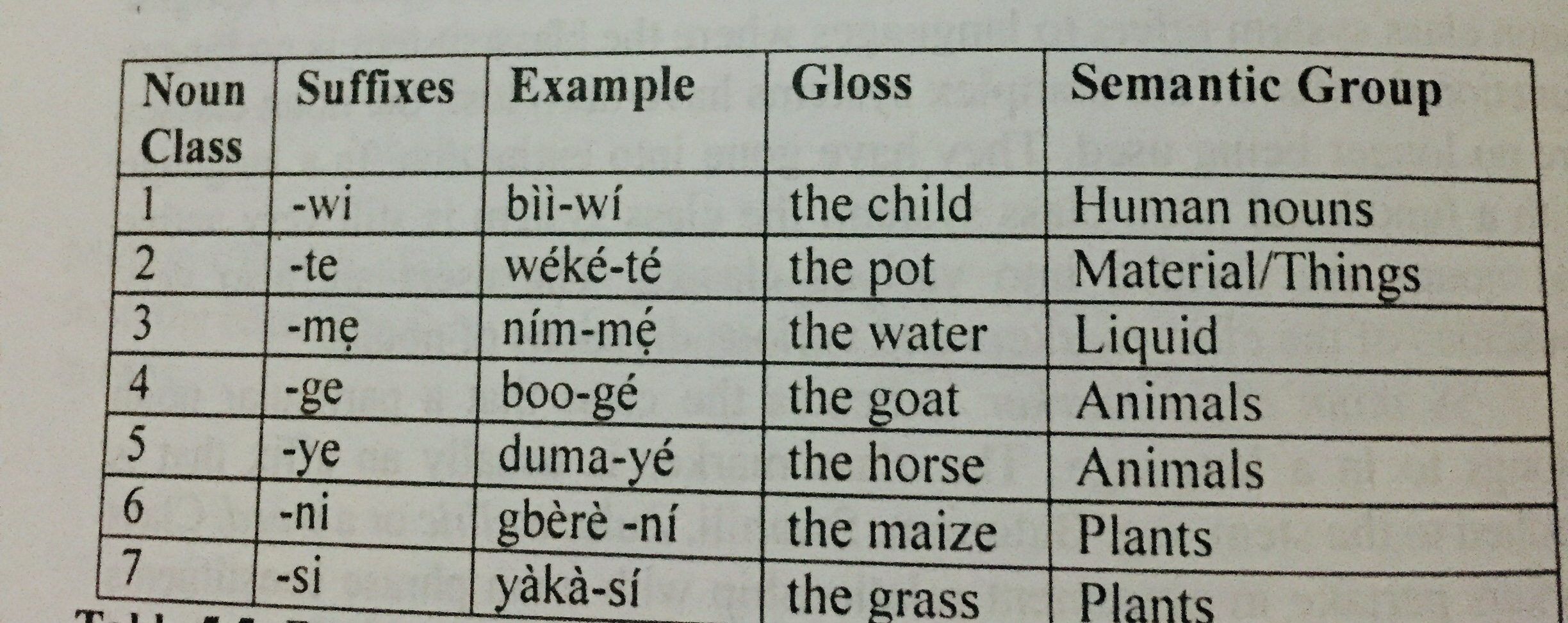
Table 1. Batonum Noun Classes 

 Batonum attests seven functional noun classes which are neatly divided morphologically and semantically.

The Batonum class markers are suffixes which function as definite determiners (Sanusi, 2001).

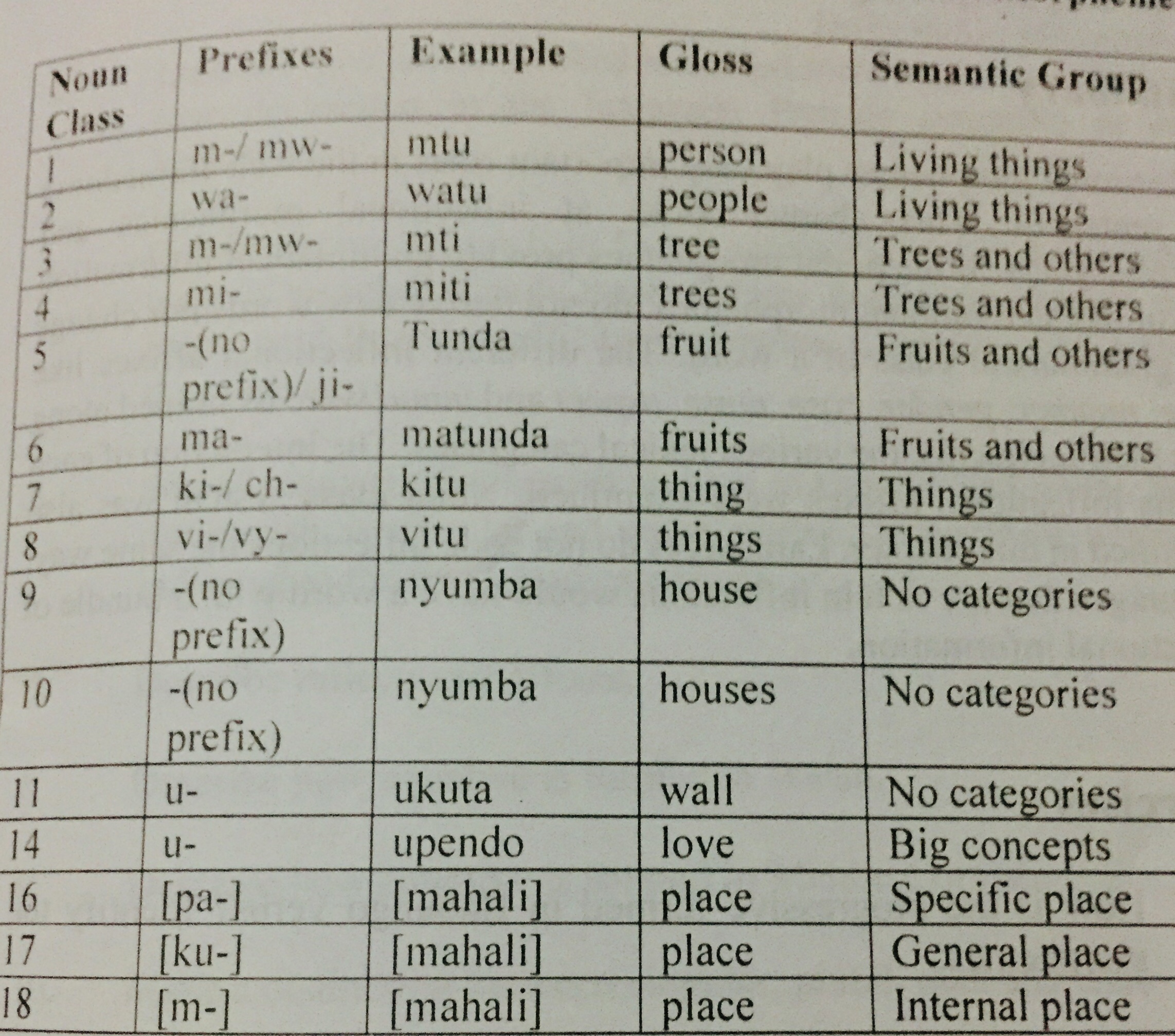
Table 2. Swahili Noun Classes

Swahili has sixteen classes of nouns which are distinguished by prefixes and can be broken into singular and plural pairs.

The nouns in most of the classes have some semantic identifications e.g. nouns in classes 1 and 2 are living things while nouns in classes 7 and 8 refer to things.

 Exercises

1. What is Noun class system?

2. Examine how the noun class is marked in at least three languages. Provide examples in each language.

NB

a. Excerpts are taken from Arokoyo (2017 and 2018).

References

Arokoyo, Bolanle Elizabeth. (2017). Unlocking Morphology. Ilorin: Chridamel Books.

Arokoyo, Bolanle Elizabeth. (2013). Unlocking focus constructions. Ilorin: Chridamel Books. https://bit.ly/2TDx9nF

Sanusi, Issa O. (2003). The Phenomenon of Noun Class Systems: The Case of Batonu. Cape Town: Centre for Advanced Studies of African Society.

Welmers, William, E. (1973). Africal Language Structures. Los Angeles and Berkeley: University of California Press.

Acronyms: A Word Formation Process

Bolanle Elizabeth Arokoyo

Morphology Lecture Series XIV

Acronyms are words formed from the initials of several words.

Word acronyms and spelling acronyms are the two types of acronyms attested in some languages.

The words are pronounced as a single word and pronounced as the spelling indicates in the case of word acronyms.

For example:

NEPA: National Electric Power Authority

WAEC: West African Examination Council

WASC: West African School Certificate

ECOWAS: Economic Community of West African States

JAMB: Joint Admission Matriculation Board

NECO: National Examination Council

LASER: Light Amplification by Stimulated Emission of Radiation.

LISA: Linguistics Students Association

LAN: Linguistics Association of Nigeria

YSAN: Yoruba Studies Association of Nigeria

Spelling acronyms are pronounced as a sequence of the initial alphabets of the words.

They are not pronounced as words but as sequence of alphabets. For example:


IQ: Intelligence Quotient

FYI: For Your Information

MC: Master of Ceremonies

UFO: Unidentified Flying Object

NUC: National University Commission

NYSC: National Youth Service Corps

CD: Compact Disc

VCR: Video Cassette Recorder

PC: Personal Computer

AU: African Union

EU: European Union

OAU: Organization of African Unity

ATM: Automated Teller Machine


With the presence of the internet making the social media a part of our lives, the importance of the language of the internet cannot be overemphasized as it has drastically increased our words through different word formation processes.

Most of the users of the social media platforms like E-mails, Whatsapp, Facebook, Messenger, Instagram, Twitter, Imo, Snapchat, 2go, etc. use acronyms and abreviations to pass their messages via chatting and short messages.

Text messages and Twitter have limited number of characters that can be used. Some of these are exemplified below.


BAE: Before Anyone Else

LOL: Laughing out Loud

YAM: Yet another Meeting

2moro: Tomorrow

ASAP: As Soon as Possible

B3: Blah Blah Blah

CTN: Cannot Talk Now

CYT: See You Tomorrow

BRB: Be Right Back

TTC: Trying to Conceive

GTC: Going to Conceive

POV: Point of View

YMMD: You Made My Day

ICYMI: In Case You Missed It

OOMF: One Of My Friends

BFF: Best Friend Forever

DYE: Down To Earth


Some of them are pronounced as spelt or as a single word. There are some that could have more than one meaning, so there is the need for an understanding of the acronyms in order for communication to take place.

Add your own to the list.

⚠️ WARNING ⚠️

Do not allow some of these acronyms and abbreviations get into your formal writing.

a. Except from Arokoyo (2017).

b. Our next lecture is on Borrowing. See Compounding also.

Arokoyo, Bolanle Elizabeth. (2017). Unlocking Morphology. Ilorin: Chridamel Books.